
Mineral County Deed Records and What They Show
Every deed moves an interest in land from a grantor to a grantee. In Mineral County, the Clerk is the office that records these instruments. No single form covers every transfer. The county publishes no master list of deed subtypes. So read the document itself. Its legal description tells you what actually changed hands. Remember that a deed of trust can bind the land. A lien can too, without being the deed that conveyed it.
| Deed Type | What It Does | Common Use |
|---|---|---|
| Deed | Conveys the interest stated in its granting language | Sale, gift, correction, or other transfer |
| Executor or administrator deed | Transfers land through a fiduciary acting for an estate | Probate and estate settlement |
| Trustee report of sale | Records a trustee’s foreclosure sale report | Foreclosure record trail |
| Deed of trust or mortgage | Records a security interest tied to land | Financing and later release search |
| Plat or agreement | Maps lots or records a land-related agreement | Subdivision, easement, or shared access |
Deeds and loan papers answer different questions. A deed records the transfer itself. A deed of trust or mortgage records security for debt instead. Later, a release, satisfaction, or assignment may be filed under a separate category. Search the whole sequence. The newest deed alone never shows every recorded claim.
Mineral County Clerk Index Lists More Than Deeds
Deeds are only the start of what the Mineral County Clerk indexes. A Mineral County property records search can turn up deeds of trust, state and federal liens, judgments, releases, cemetery deeds, church trustee filings, trustee reports of sale, plat maps, assignments, agreements, affidavits, and restricted military discharges. The landing page itself keeps quiet on some practical details. Required fields, year coverage, image availability, and copy fees only come into view once a searcher digs in, so the Clerk's office is the right place to confirm anything unclear.
Start at the Mineral County WV Land Records index and pick the document class that fits your deed records question. For a wider view of the office, the county's own Clerk records page lays out duties that reach past deeds into leases, rights-of-way, wills, powers of attorney, probate, and vital records.
See the Mineral County land-record index for supporting context. 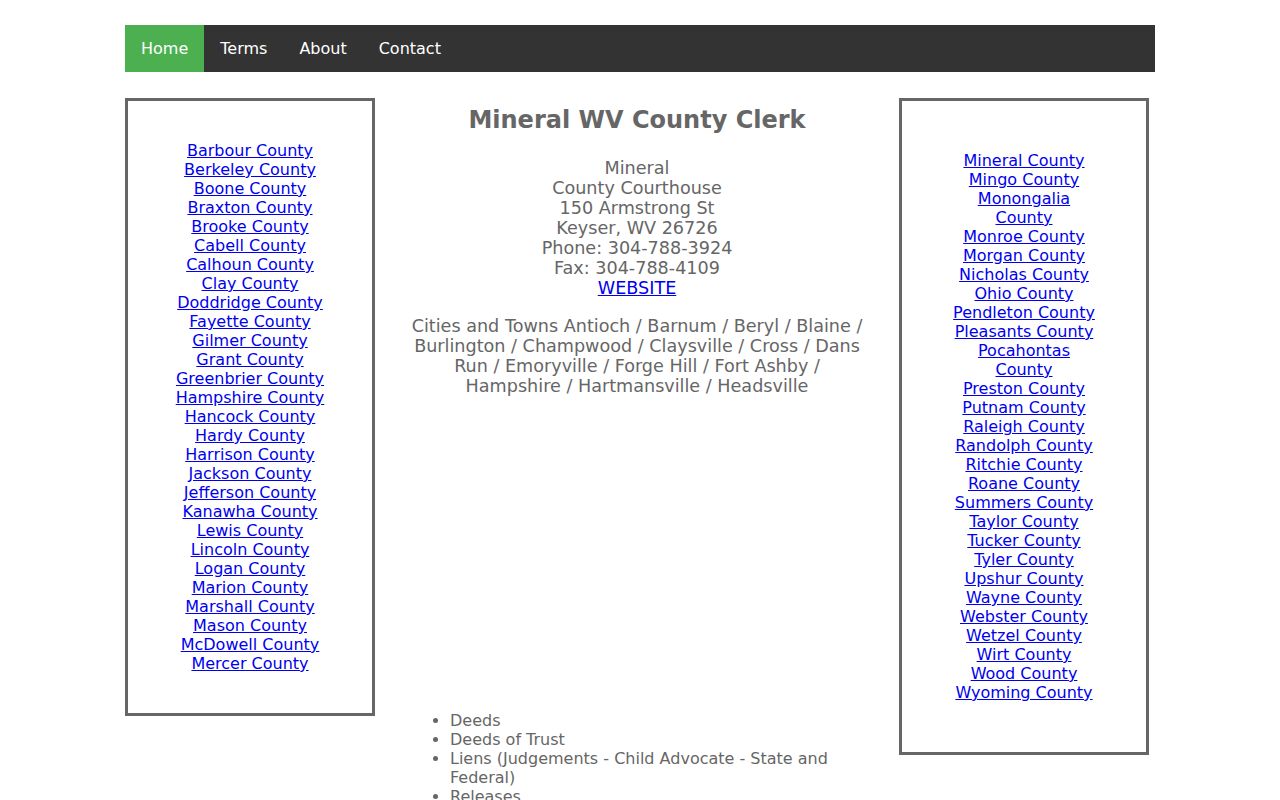 shows the county index landing page. It is a starting list, not proof that every listed image or year is searchable online.
Mineral County Recorded Documents Have Separate Roles
The County Clerk records many document types. The official list runs long: deeds, leases, rights-of-way, plats, wills, deeds of trust, mortgages, releases, judgments, liens, abstracts, assignments, powers of attorney, church trustees, bonds, and DD-214 military discharges. WV Land Records adds cemetery deeds and foreclosure trustee reports to that mix. Access rules vary. Military discharges are marked restricted. Vital or probate files may carry limits of their own.
Each record serves its own purpose. A plat maps lots and easements. It does not prove who owns a lot today, though. A release can clear one mortgage reference. Judgments, easements, taxes, and court records can still cloud the title. A deed name may differ from a later company or estate name. In that case, the legal description and parcel number become the bridge.
See the Mineral County Clerk page for supporting context. 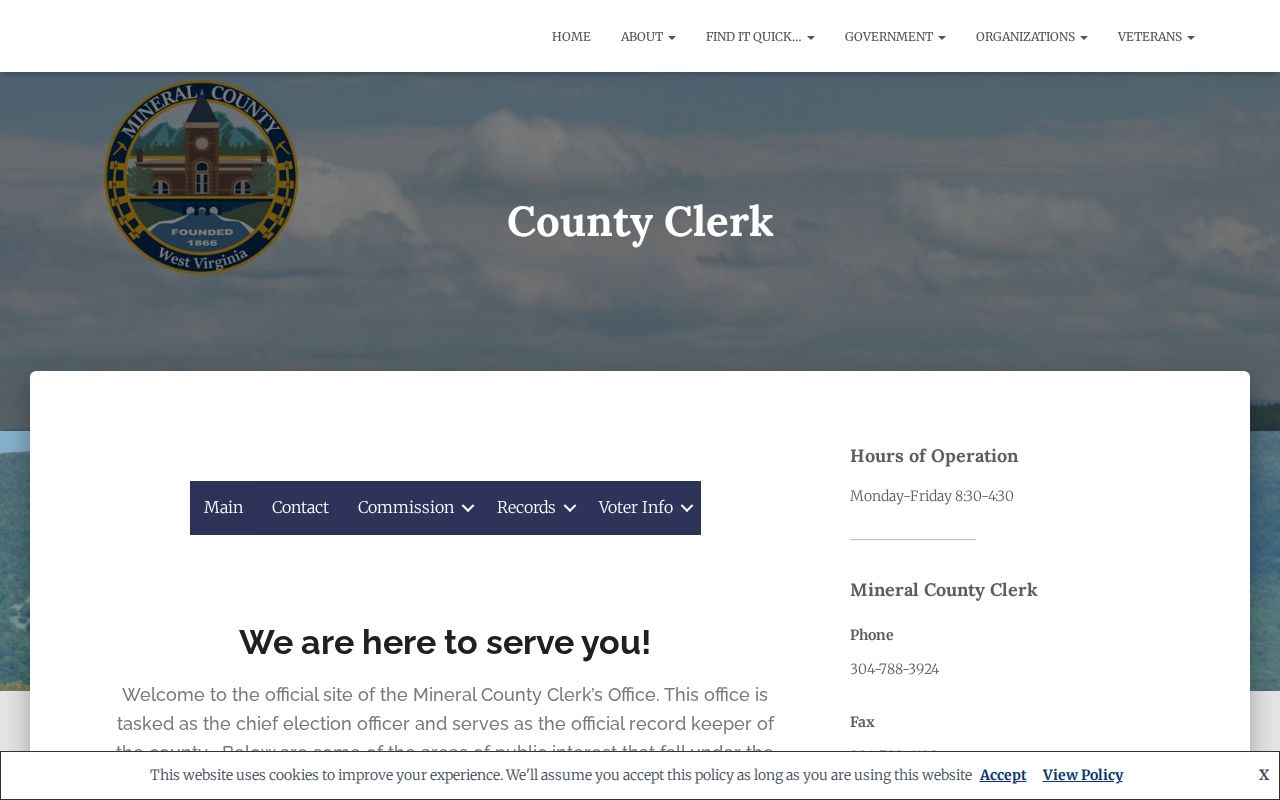 connects the public category list to the office that keeps the record. The County Clerk is at the courthouse in Keyser, and the published phone number can be used to ask about a specific book or document.
The Mineral County Grantor-Grantee Index
A grantor-grantee index lets you trace a recorded transfer from either side of the deal. Start from a known deed, the current assessment owner, or a legal description. The online Mineral County landing page names document types. It hides its exact search fields and oldest indexed year. Treat missing web results with caution. An absent hit does not mean no instrument exists. The Clerk must confirm coverage and the older book indexes.
- Find the deed where the known owner appears as grantee, the party receiving the interest.
- Read the prior grantor, recording date, book and page or instrument reference, and legal description.
- Search that grantor as an earlier grantee, using the legal description to check that it is the same land.
- Repeat the handoff backward, noting estate, trust, name, and parcel changes along the way.
- When the online trail ends, ask the Clerk for the deed books and grantor-grantee indexes for the needed period.
- Grantor
- The person or entity conveying the interest described in a document.
- Grantee
- The person or entity receiving that interest.
- Chain of title
- The sequence of recorded transfers that links prior owners to the present record.
- Book and page
- A reference to a document’s place in a bound or indexed record series.
- Legal description
- Words that identify the land, such as lot and block or metes and bounds.
Copy names exactly as indexed, then note spelling variants too. A married name, trust, estate, or middle initial can shift how a party appears. Across older deeds, the legal description usually holds steadier than a street address.
Mineral County’s Online Deed Cutoff Is Unconfirmed
Neither the Clerk's page nor the online index states a start year for searchable Mineral County records. No imaging conversion date or complete digital chain is published either. Treat the web index as a convenience for whatever period it spans. It is not proof that older transfers never existed.
For a deed that predates the online results, contact the County Clerk at the courthouse, 150 Armstrong Street, Keyser, WV 26726, or call 304-788-3924. Ask which deed book and grantor-grantee volume covers your date range. WV Archives also lists a 1941 Mineral County archives inventory and an 1875 land sketch, both helpful for framing an older request.
Coverage check. The web index’s earliest year is not verified. Ask the Clerk for book and index coverage before concluding that an earlier deed was not recorded.
The State Archives, the Keyser-Mineral County Public Library, and Potomac State collections can help identify names and land references. Still, the deed book or recorded image remains the source for the instrument itself.
Mineral County Deed Books Need a Land Match
Mineral County deed books rarely sort well by name alone. Write down five things for every document. These are the grantee, grantor, date, book and page or instrument number, and the legal description. Older books often skip street addresses entirely. Rural route and PO-box text is not an E-911 location. A description may mention acreage, a district, map, parcel, road, stream, or adjoining tracts. Compare those details across records.
A common surname needs extra care. Pull the parcel card first. This pins down the current district and map. Then match the deed's written boundaries or lot number against the recorded plat. Parcels and addresses do change over the years. The Clerk can supply a plat or subdivision record. The Assessor holds the current card. Remember that a tax map only points you to a tract. It never replaces the deed description itself.
The Clerk's county index landing page leaves several questions open. These include full search fields, exact pagination, and book/page conversion rules. An assessment reference that fails in the online form is not a dead end. Call the office and ask how it is indexed.
Mineral County Releases Follow Mortgages
In Mineral County, a deed of trust or mortgage can sit in the index far from the deed that moved ownership. Start your search with the original parties. Then hunt for assignments, releases, and satisfactions under the borrower, lender, trustee, or a later holder of the note. A release is sometimes recorded years after the debt was settled, so match dates and legal descriptions rather than trusting one shared surname.
The Clerk records more than deeds. Liens, judgments, agreements, rights-of-way, and affidavits pass through the office as well. A mechanic's lien or court judgment may tie back to a Circuit Court case. Use the land index for the recorded instrument and the court docket for litigation status. Any county tax balance belongs with the Sheriff-Tax Office.
Mineral County offers no single online title report. A careful deed review looks past the transfer itself. Later releases and competing interests matter just as much.
Mineral County Foreclosure Records Cross Offices
Mineral County's land index lists a "Trustees Report of Sale for Foreclosures." A related Circuit Court case can hold more. It may include a foreclosure complaint, lis pendens, judgment, sale confirmation, or redemption matter. Search the Clerk's recorded documents and the West Virginia Judiciary public-access route separately. The Judiciary route spells out no exact PACT form fields or result coverage, so an older or detailed file may take a court clerk request.
Tax sales run through a different door. The Sheriff-Tax Office reports that unpaid delinquent real estate goes to an annual sale in November, while the Clerk handles redemption for parcels sold to individuals at that sale. The current list, bidder rules, redemption period, and publication venue are not posted online. Request the current notice directly. Ask the Sheriff or Clerk for parcel-specific status.
Mineral County publishes no property-fraud alert signup. Ask the Clerk whether recording notices exist. Then skip any letter that demands a large fee for a deed copy or alert enrollment.
Mineral County DD-214s Have Restricted Access
DD-214 military discharge records appear on the Mineral County Clerk's document list, but the WV Land Records category carries a restricted-access flag. This is no ordinary public deed image. Ask the Clerk about eligibility and access rules before filing a request. The public land index will not surface a DD-214 as an unrestricted search result.
That restriction sinks the claim that everything is online. Land, probate, vital, court, and military records answer to different custodians and disclosure rules. The Clerk can confirm whether a record is held locally. The office can also point to the right request path.
Getting a Copy of a Mineral County Deed
A book/page or instrument reference is all you need, plus the legal description. You can then request a Mineral County deed copy from the County Clerk. The index landing page posts no fee schedule. Call to ask about download options, certified copies, and whether oversized plat sheets cost extra. The Clerk sits at 150 Armstrong Street in Keyser. The phone number is 304-788-3924.
Some deeds never made it online. The Clerk can search the deed books and indexes for the year you need. A written request under the West Virginia Freedom of Information Act works well for this. Name the record custodian first. Add the parcel or the parties, the document type, and the date range. The law allows five days for a response, not counting weekends and legal holidays. That reply may simply state when inspection or copies will be ready.
Recorded, not guaranteed. A Mineral County deed image shows an instrument in the public record. It does not prove that the full chain is clear or that no unrecorded interest exists.
Older deeds sometimes hide in other collections. The WV Archives posts a Mineral County archives inventory and an early land sketch. At the Keyser library, the J.C. Sanders Papers hold deeds and wills, and newspaper reels can yield names and address clues. Treat any of these as a lead first. Then confirm the transfer in the Clerk’s own deed records before you rely on it.